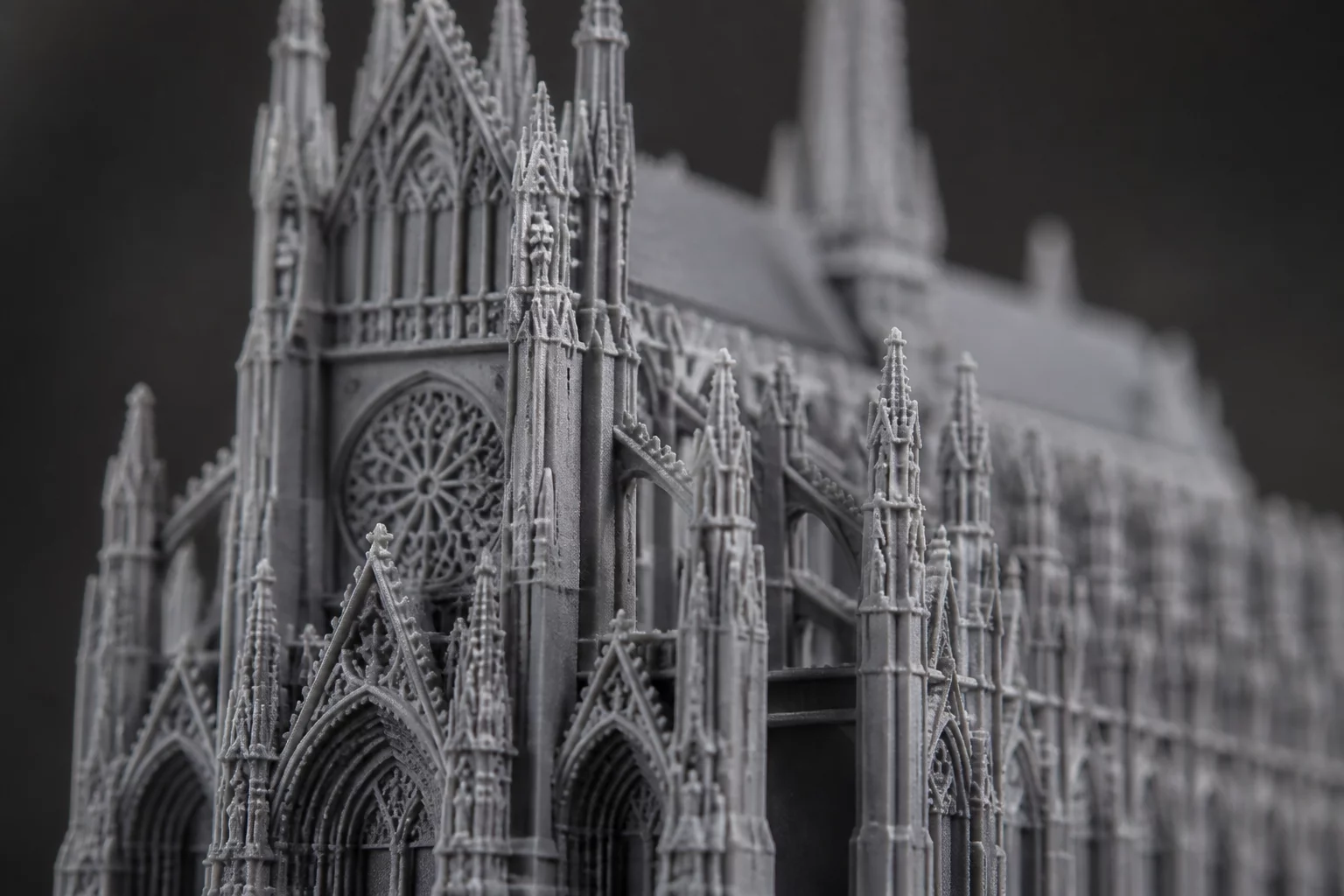
Introduction to Water-Washable Photopolymers
Water-washable resins have gained massive popularity among 3D printing enthusiasts and professionals looking to bypass the strong odors and handling challenges of isopropyl alcohol (IPA). While the convenience of washing models in plain water is undeniable, a key question remains: does this formulation compromise the retention of micro-details? We ran systematic tests to evaluate how fine features, thin walls, and sharp edges behave under standard exposure and washing cycles.
The Chemistry of Water Washability and Detail Loss
Standard resins require solvent-based cleaning because their hydrophobic monomers do not dissolve in water. Water-washable resins incorporate hydrophilic groups into their chemical structure, allowing the uncured resin to mix with water molecules. However, this affinity for water makes the cured material more susceptible to water absorption during the cleaning process. If a model remains submerged for too long, the outer layers swell slightly, leading to rounded edges and a loss of microscopic textures.
Exposure Calibration and Light Bleeding
Our tests revealed that water-washable resins tend to have a slightly higher light-bleeding effect compared to standard model resins. Because of the modified monomer formulations, light scatters more easily through the liquid layer. To preserve recessed text and micro-holes, we had to reduce the normal exposure time by 0.2 seconds and increase the light-off delay. This modification helps prevent the resin from curing in unintended areas, ensuring that fine details remain sharp.
Wash Cycle Testing: Finding the Sweet Spot
Washing is the most critical stage for detail preservation. Standard resins can withstand a few minutes in IPA without significant structural changes. In contrast, water-washable resins require immediate and precise washing. We recommend a two-stage wash cycle:
- Primary Wash: Agitate the printed model in a water bath for no more than 60 seconds to remove the bulk of the uncured resin.
- Detail Clearing: Use a soft-bristled brush or a gentle spray bottle to clear out recessed channels, micro-holes, and tight joints.
- Thorough Drying: Blow-dry the model immediately with compressed air. Allowing water to sit on the surface leads to white residue and structural softening.
Post-Curing and Shrinkage Analysis
Once dry, post-curing is necessary to achieve full mechanical strength. Water-washable resins exhibit slightly higher volumetric shrinkage during post-curing—typically between 1.5% and 2.2%. This shrinkage can cause thin walls to warp or interlocking joints to bind if exposure during curing is uneven. Rotating the model continuously inside the UV chamber helps minimize these dimensional discrepancies.
Frequently Asked Questions
Does water-washable resin lose details compared to standard resin?
Under optimal settings, the difference in detail retention is negligible. However, water-washable resin is less forgiving during the washing stage. Prolonged exposure to water swells the fine features, which can permanently blur crisp edges.
How do you prevent white residue on water-washable prints?
White residue occurs when water containing dissolved uncured resin dries on the model. To prevent this, rinse the print in clean water as a final step, then blow-dry it completely using compressed air before post-curing.
Add Your Perspective