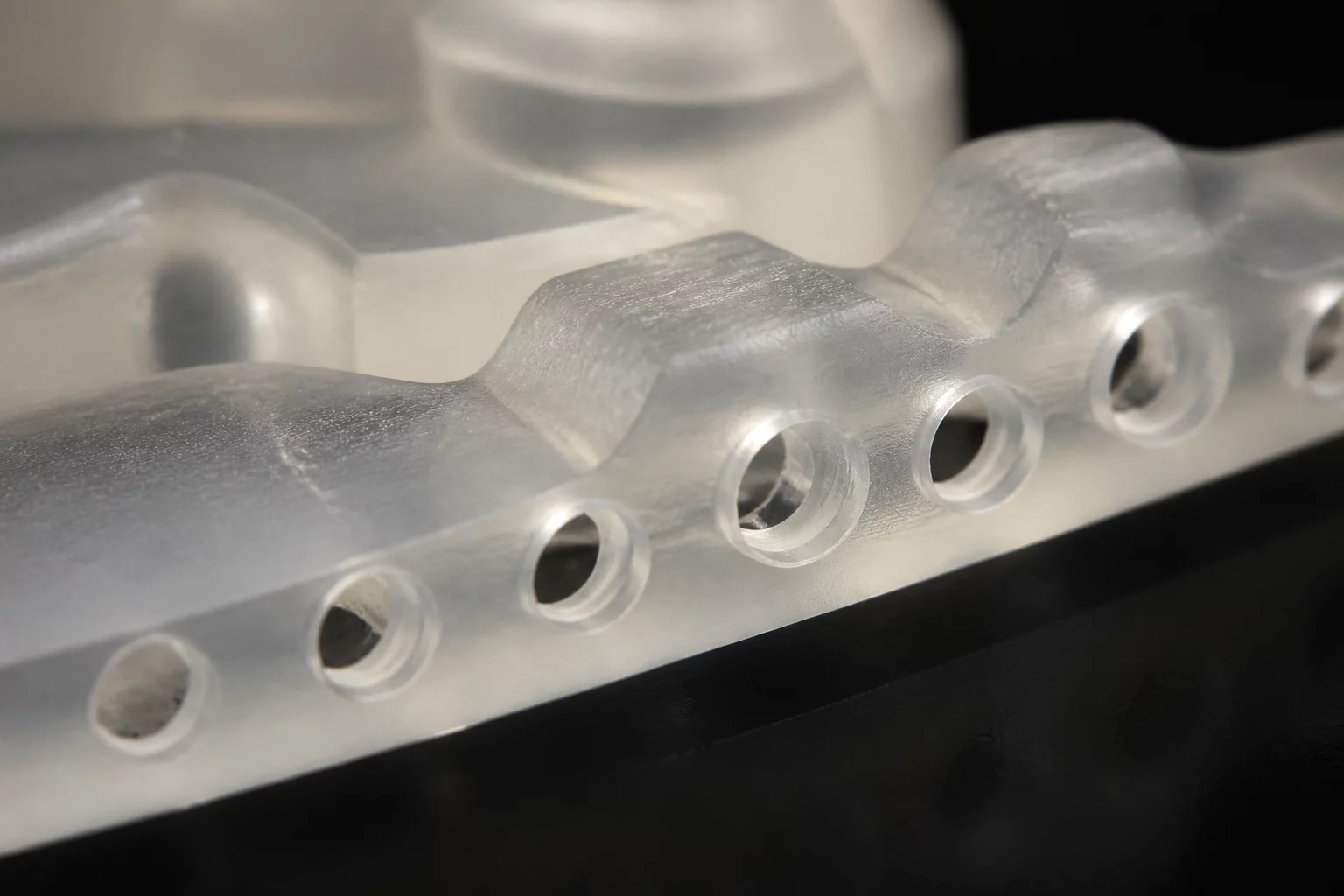
Achieving a reliable Micro-Hole Tolerance in Dental Resins is a cornerstone of modern digital dentistry. In applications such as implant surgical guides and complex orthodontic appliances, microscopic holes (typically 0.3mm to 0.8mm) are essential for alignment pins and irrigation channels. This case study examines why these features often print smaller than their digital counterparts and how to calibrate for consistent results.
The Phenomenon of Curing Bleed
The primary technical hurdle in printing negative micro-features is light bleed. During the layer-by-layer photopolymerization, UV light scatters slightly beyond the intended pixel geometry. In a 0.5mm hole, a light bleed of just 20 microns on the perimeter reduces the total diameter by 40 microns. While this seems negligible, it represents an 8% dimensional error, often enough to prevent a metal guide sleeve from seating correctly.
"In precision dentistry, a 50-micron deviation isn't just a margin of error—it's the difference between a successful procedure and a surgical guide failure."
Resin Viscosity and Surface Tension
Viscosity plays a hidden role in hole tolerance. Highly viscous dental resins tend to linger inside narrow voids during the build process. If the washing stage is not aggressive enough, this trapped uncured resin is exposed to ambient UV during post-curing, further constricting the hole diameter. We observed that ultrasonic cleaning in fresh IPA for at least 5 minutes is mandatory for clearing channels below 0.6mm.
Key Observation Factors:
- Light Scatter: Pixel pitch vs. curing depth.
- Layer Height: The influence of Z-axis resolution on hole wall smoothness.
- Orientation: Why vertical holes outperform horizontal ones in circularity.
- Washing Protocol: The necessity of pressurized air to clear micro-channels.
Clinical Accuracy Results
Our testing using an 8K monochrome LCD printer showed that without compensation, a 0.50mm hole consistently printed at 0.44mm. By implementing a global CAD offset of +0.06mm and reducing the normal layer exposure by 0.2 seconds, we achieved a final tolerance of ±0.015mm across a batch of 20 dental guides. This demonstrates that software-level compensation is just as vital as hardware precision.
Micro-Hole Calibration FAQ
Why are my small holes closing entirely?
This is usually caused by over-exposure. If your base layers or normal layers are exposed for too long, the light bleed bridges the gap of the micro-hole. Try reducing your exposure time in 0.1s increments.
Does post-curing affect the final diameter?
Yes, photopolymer resins undergo secondary shrinkage during the final UV curing stage. We found that dental resins can shrink by an additional 1-2% during this phase, further narrowing small voids.
Add Your Perspective