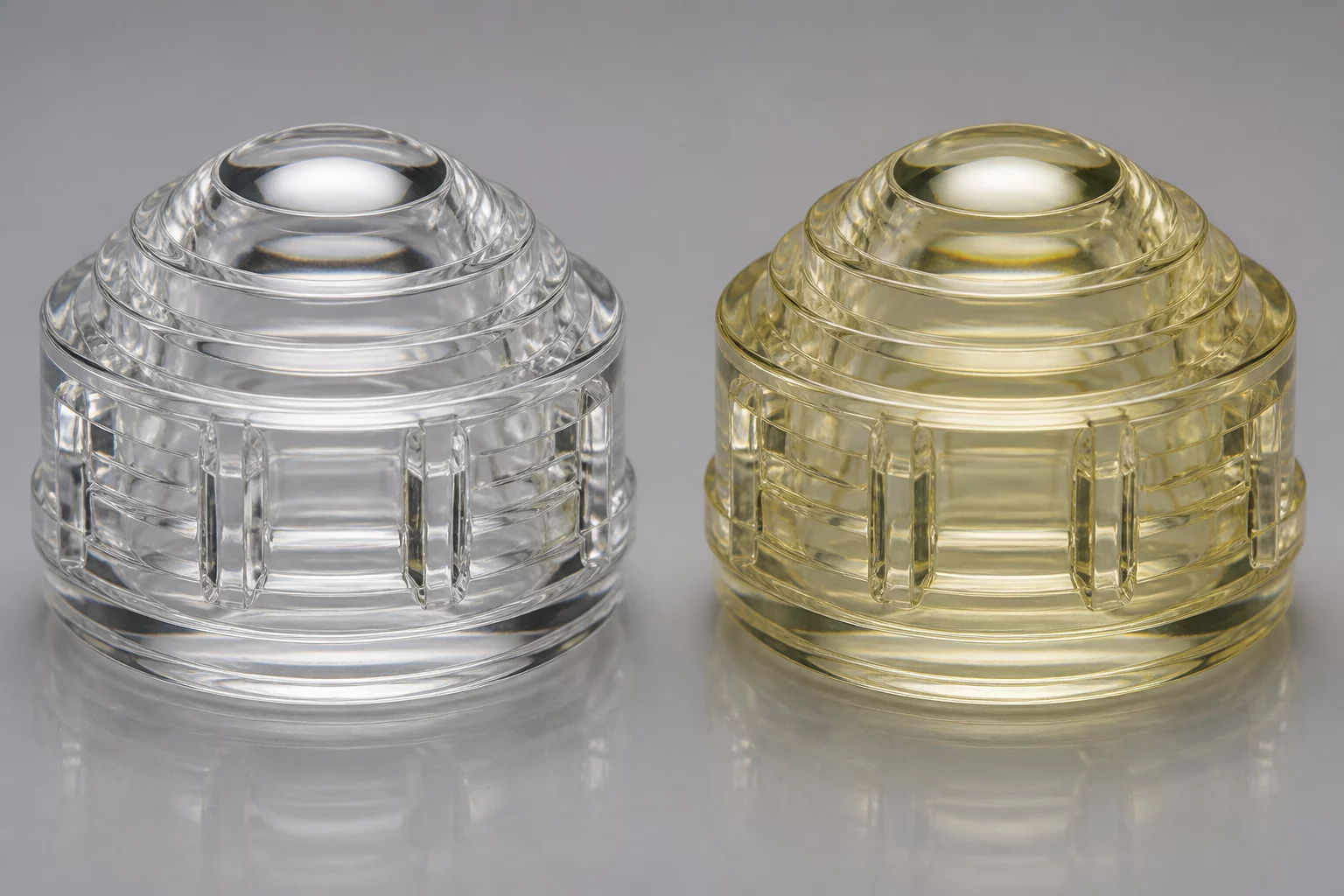
For optical components, lenses, light guides, and fluidic devices, maintaining absolute transparency in 3D prints is a persistent challenge. Over time, exposure to ultraviolet (UV) radiation triggers photo-oxidation in cured photopolymers, resulting in a distinct amber or yellow tint. In this study, we subject three popular ultra-clear resins to accelerated UV aging to measure their yellowing index (YI) and light transmission loss over a simulated 30-day period.
Understanding the Chemistry of Yellowing
Yellowing in photopolymer resins occurs due to the degradation of photoinitiators and polymer chains when exposed to light or heat. Unreacted photoinitiators (typically TPO or BAPO) are highly sensitive to near-UV wavelengths. When they absorb ambient UV, they undergo photolysis, forming colored degradation byproducts. Additionally, oxidation of the acrylate backbone under heat or sunlight creates conjugated structures that absorb blue light, causing the material to appear yellow.
Accelerated Aging Test Methodology
To test the longevity of optical clarity, we prepared specimens measuring 20mm x 20mm x 5mm. All specimens were sliced at a 50-micron layer height, printed on a monochrome LCD printer, washed in isopropyl alcohol (IPA) for exactly 5 minutes, and dried. The post-curing was conducted under different parameters (dry curing versus water-submerged curing) to evaluate oxygen inhibition effects. Finally, the parts were placed in a UV weathering chamber with a constant exposure of 10 W/m² at 365nm and 405nm wavelengths.
Key Performance Metrics
We monitored the specimens at regular intervals (0 hours, 24 hours, 72 hours, 168 hours, and 720 hours) using a spectrophotometer. The primary measurements recorded were:
- Yellowing Index (YI-D1925): Quantifies the departure of a sample from colorlessness toward yellow.
- Total Luminous Transmittance (Tt): The percentage of incident visible light passing through the 5mm thickness.
- Haze: The percentage of transmitted light that deviates from the incident beam by forward scattering.
Test Results and Comparative Data
The test revealed that the post-curing method has a significant impact on initial yellowing. Specimens post-cured dry in ambient air showed a 15% higher initial Yellowing Index than those cured submerged in water. Water-submerged curing prevents oxygen inhibition, allowing for a faster and more complete surface cure with less cumulative heat generation. After 720 hours of accelerated exposure, all resins exhibited some degree of yellowing, but the rate of degradation varied widely. The high-performance polyurethane-based clear resin retained 88% of its original light transmission, while the standard acrylic-based clear resin dropped to 72% transmission with a YI exceeding 18.2.
Actionable Recommendations for Maximum Clarity
To achieve and preserve glass-like transparency in your prints, implement the following processing protocol:
- Optimize Post-Curing: Cure your clear prints submerged in clean, demineralized water. Keep the curing time to the minimum required to achieve mechanical stability (typically 2 to 5 minutes depending on UV intensity). Over-curing is the number one cause of immediate yellowing.
- Apply UV-Blocking Varnishes: Coating the washed and cured parts with a UV-resistant clear acrylic spray blocks ambient UV radiation and seals the surface, significantly delaying photo-oxidation.
- Use Thermal Stabilization: Avoid exposing clear parts to high temperatures during cleaning or drying, as thermal oxidation accelerates yellowing.
Add Your Perspective