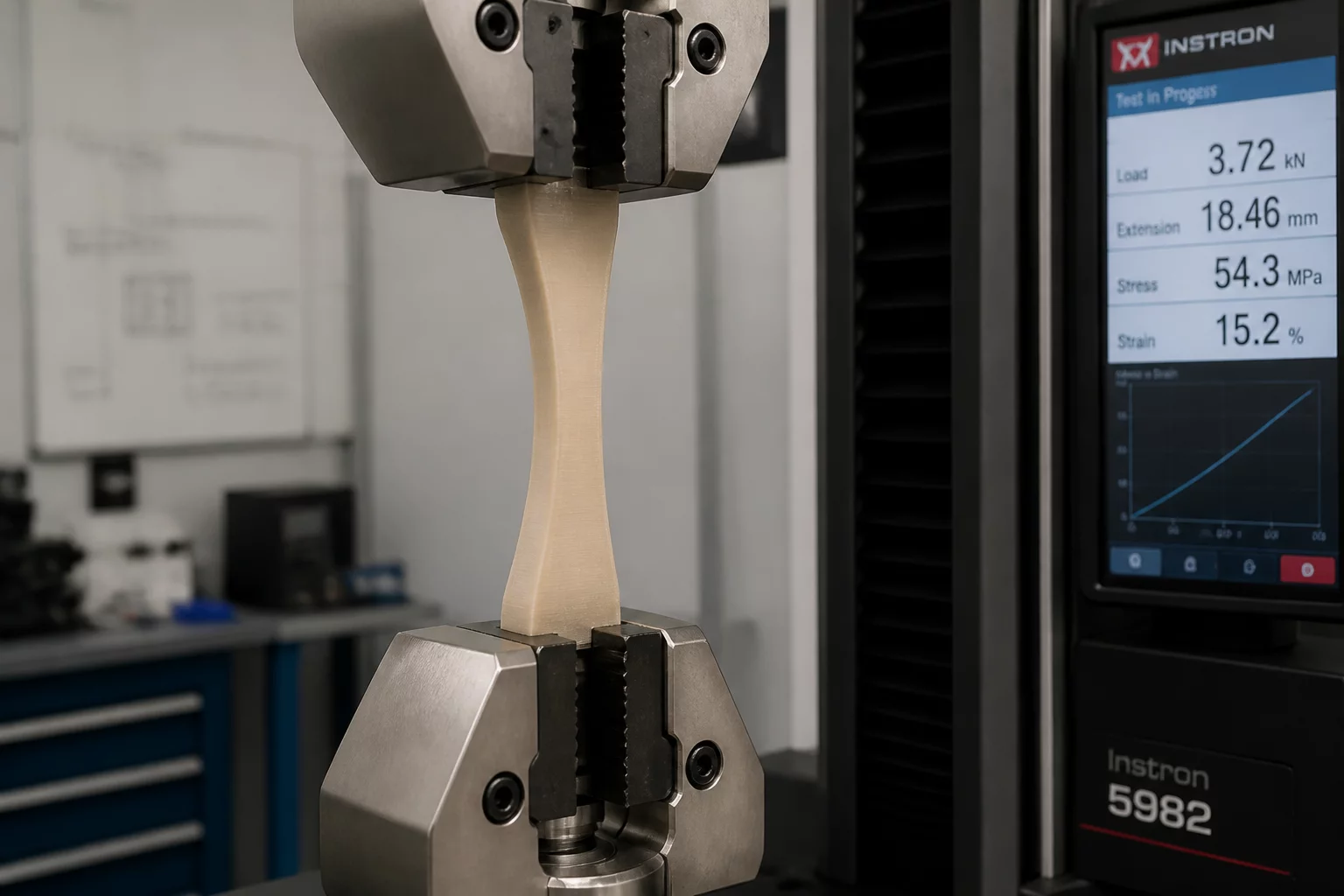
Welcome to our detailed High-Toughness Engineering Resin Analysis. In the rapidly evolving landscape of photopolymer 3D printing, structural integrity and mechanical durability remain paramount. Standard model resins often fail under stress, resulting in brittle fractures. Engineering-grade resins seek to solve this issue by offering a balance between tensile strength and elongation. This technical evaluation examines the mechanical performance, printability, and long-term durability of various high-toughness formulations to determine their suitability for functional prototypes and end-use parts.
Tensile Strength and Elongation Performance
To understand how tough resins behave under stress, we conducted a series of mechanical tensile tests on standardized dogbone specimens. Unlike standard resins that break at less than 10% elongation, engineering-grade tough photopolymers exhibit elongation at break values ranging from 30% to over 80%. This elasticity allows parts to bend and absorb energy before failing.
We observed that curing time directly impacts these values. Under-cured parts show high flexibility but low tensile strength, whereas over-cured parts become brittle. Achieving the optimal balance requires precise post-curing schedules, typically involving thermal cycles alongside UV exposure.
Impact Resistance and Shock Absorption
Impact strength is the defining characteristic of high-toughness resins. We performed Izod notched impact tests to measure energy absorption. The results indicate that these formulations absorb up to five times more energy than standard rigid resins.
This makes them ideal for snap-fit joints, enclosures, and protective gear. However, the high polymer density of tough resins increases viscosity, which can lead to printing challenges such as bubble entrapment and separation forces on the FEP film.
Dimensional Accuracy and Slicing Configurations
High-toughness resins tend to shrink more during post-curing than their rigid counterparts. This volumetric shrinkage, often between 2% and 4%, requires compensation in your slicer settings.
Using professional slicers like CHITUBOX, you must apply scaling factors to ensure final parts match your CAD designs. Additionally, longer exposure times per layer are necessary to secure cross-linking, which slightly reduces fine feature resolution.
Frequently Asked Questions
Do tough resins degrade under ambient light?
Yes, prolonged exposure to sunlight will continue the curing process, eventually causing the material to become brittle. Applying a UV-blocking clear coat is highly recommended.
Can tough resin be mixed with standard resin?
Yes, mixing tough resin with standard rigid resin (often in a 70:30 ratio) is a common practice to add slight durability to models without losing fine detail.
What is the best cleaning agent for these prints?
Isopropyl alcohol (IPA) remains the standard, but because of the resin's high viscosity, ultrasonic cleaning or vigorous washing is required to clean recessed features.
Add Your Perspective