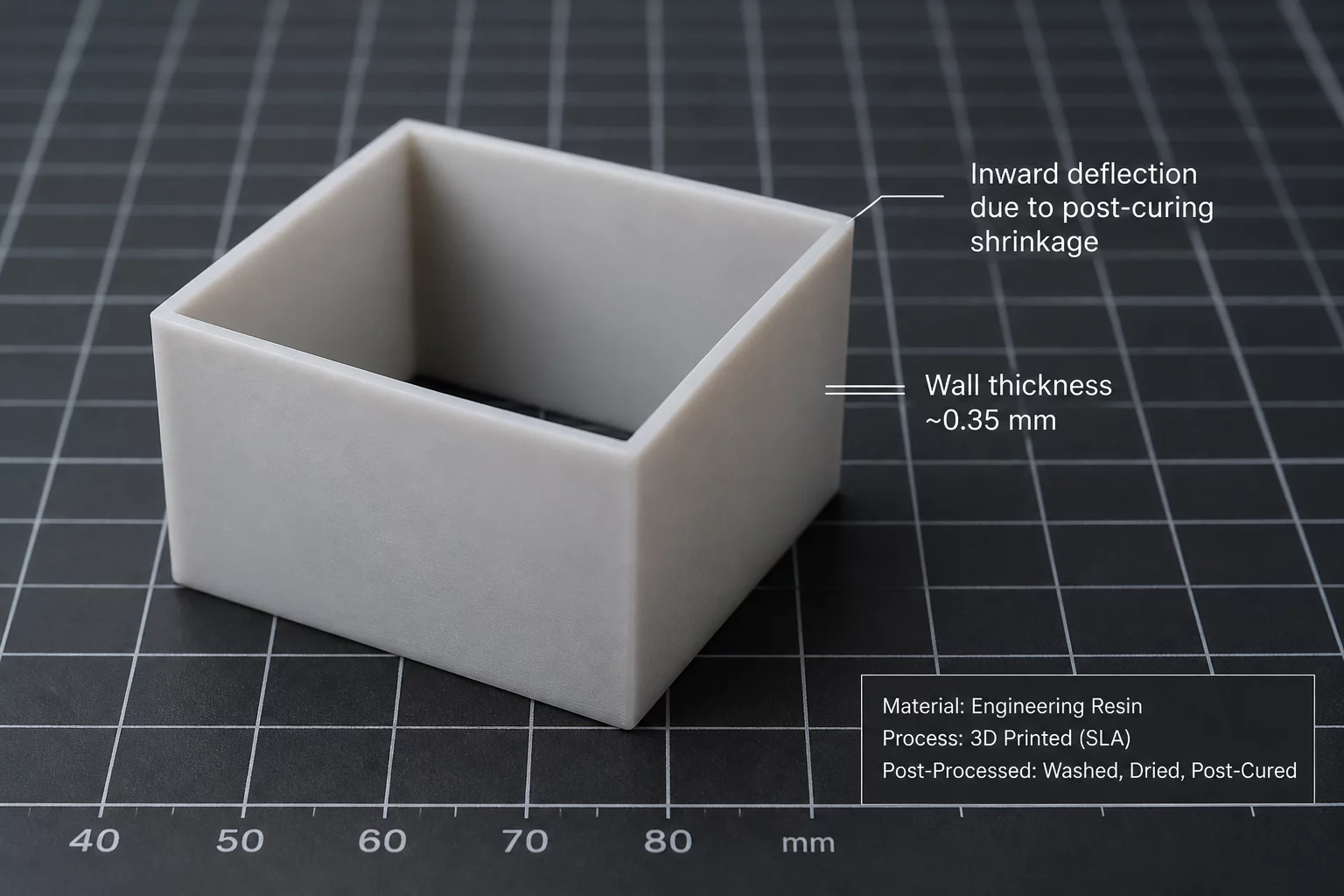
Understanding the Shrinkage Mechanism in Thin Walls
In high-precision stereolithography (SLA) and masked stereolithography (MSLA) 3D printing, achieving dimensional accuracy in thin-walled features is a persistent challenge. When photopolymer resins cure, they undergo molecular cross-linking. This chemical transition from liquid monomers to a solid polymer network inherently reduces the volume of the material, a phenomenon known as polymerization shrinkage.
During the printing phase, parts are only partially cured (often called the "green" state) to prevent excessive adhesion to the FEP film and speed up print times. The final material properties are achieved during post-curing, where the print is exposed to intense 405nm UV light. However, for thin walls (typically under 1.2mm), this step introduces severe stress. Because UV light penetrates the thin geometry rapidly, any slight gradient in light absorption or heat distribution causes uneven contraction, resulting in inward warping or bowing.
Experimental Method and Measurement
To analyze the exact impact of post-curing on thin structural elements, our team conducted a test using a series of open-topped calibration boxes. The walls of these boxes ranged from 0.4mm to 1.5mm in thickness. We utilized a standard prototyping resin and an engineering-grade tough resin, both cured at a standard 50-micron layer height.
Dimensional measurements were taken at three stages: immediately after printing (green state), after washing in isopropyl alcohol (IPA), and after a standard 10-minute UV post-curing cycle in a rotating chamber. The results indicated that while thicker walls (above 1.2mm) showed minimal deformation (under 0.3%), walls below 0.8mm exhibited significant inward warping, with deviation values reaching up to 2.8% of their nominal width.
Key Strategies to Mitigate Thin-Wall Warping
Mitigating shrinkage in delicate elements requires a combination of slicer optimization, design adjustments, and controlled post-processing workflows. Through rigorous testing, we identified the following highly effective solutions:
- Water-Submerged Curing: Post-curing the parts while submerged in a clear glass container of water. Water acts as an oxygen barrier, preventing oxygen inhibition on the resin surface and distributing heat more evenly across the thin structure.
- Geometry Reinforcement: Integrating structural ribs, gussets, or internal fillets at the base of thin walls. These features distribute the contraction forces and provide mechanical resistance against bending.
- Gradient Post-Curing: Utilizing low-intensity UV setups or pulsing the UV light in short intervals to prevent rapid heat buildup, which is a major driver of thermal warping in thin sections.
Frequently Asked Questions
Why do thin walls warp more than thick solid sections?
Thin walls have a very high surface-area-to-volume ratio. This makes them highly susceptible to uneven UV penetration and heat dissipation. In contrast, thick solid sections have more bulk material to resist localized shrinkage forces, distribute stresses more evenly, and maintain overall structural integrity.
Can slicing software compensate for post-curing shrinkage?
Yes, advanced slicing software like CHITUBOX allows you to set dimensional calibration profiles. By applying a minor scaling factor (usually 1.01x to 1.02x) specifically along the axes of thin features, you can compensate for the predictable volumetric shrinkage that occurs during the final cure.
Add Your Perspective